RAG-Implemented Chatbot AI Mechanics
Architecture of Precision: Implementing Retrieval-Augmented Generation (RAG) for AI Chatbots
Generative AI and Large Language Models (LLMs) have revolutionized natural language understanding, enabling machines to generate human-like text across diverse domains. However, standard pre-trained LLMs face significant limitations when deployed in enterprise settings: they lack access to proprietary corporate knowledge bases, cannot fetch real-time updates, and frequently output "hallucinations"—factually inaccurate responses presented as confident truths.
Implementing Retrieval-Augmented Generation (RAG) solves these limitations by grounding LLM responses in verifiable external data sources. Exploring structured AI architecture guides provides developers with the blueprint needed to build production-grade, context-aware conversational bots.
In this deep dive, we examine how RAG pipelines process data, compare vector databases, and break down augmented prompt engineering.
The Three Structural Phases of a RAG Pipeline
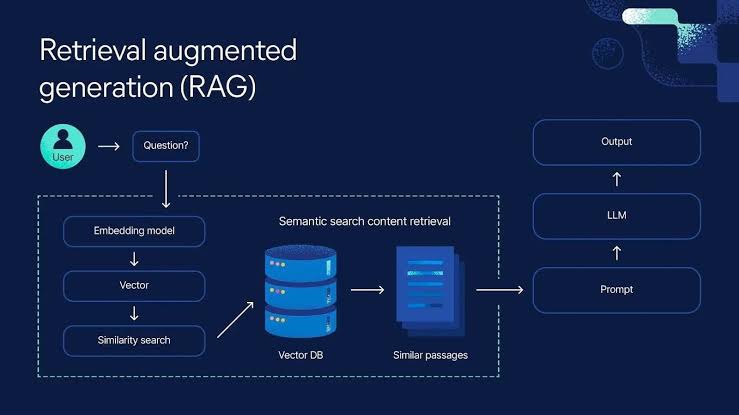
A production-ready RAG system transforms raw enterprise documents into real-time vector representations:
+-----------------------------------------------------------+
|                  1. Document Ingestion                    |
|   Raw Docs -> Chunking -> Vector Embedding Model          |
+-----------------------------------------------------------+
                              |
                              v
+-----------------------------------------------------------+
|                 2. Semantic Vector Search                 |
|   User Query -> Vector Similarity Lookup in Database      |
+-----------------------------------------------------------+
                              |
                              v
+-----------------------------------------------------------+
|                3. Context-Augmented Generation            |
|   LLM receives: [ Retrieved Passages ] + [ User Query ]   |
+-----------------------------------------------------------+
Phase 1: Ingestion and Vector Embedding
Document Chunking: Unstructured documents (PDFs, Markdown files, API docs) are split into logical text blocks (e.g., 500-token chunks with 50-token overlaps).
Generating Embeddings: Text chunks pass through an embedding model (e.g.,
text-embedding-3-small) to convert textual meaning into dense numerical vectors stored in a specialized vector database.
Phase 2: Semantic Vector Retrieval
When a user submits a query, the RAG system converts the prompt into a vector and executes a mathematical similarity search (such as Cosine Similarity) against stored document vectors, returning the top matching snippets.
Phase 3: Augmented Generation
The system constructs an augmented prompt containing both the user query and the retrieved context snippets:
System Prompt Example:
"Answer the user's question using ONLY the provided context snippets below. If the context does not contain the answer, state 'Information not available in knowledge base.' Do not assume or hallucinate information."
Why Enterprise Engineering Prefers RAG Over Fine-Tuning
| Metric / Requirement | Model Fine-Tuning | RAG Architecture |
|---|---|---|
| Data Update Frequency | Requires costly, slow re-training | Instant updates by inserting new vector entries |
| Source Citation | Opaque (Cannot cite specific source files) | Transparent (Refers directly to retrieved document chunks) |
| Data Privacy & ACLs | Hard to restrict access levels | Easy to filter vector queries by user permissions |
Integrating vector databases with low-latency backend APIs allows engineering teams to deploy reliable, high-accuracy conversational AI agents. Exploring practical AI implementation concepts on Root Learning equips developers to construct enterprise-grade AI assistants that transform user access to information.